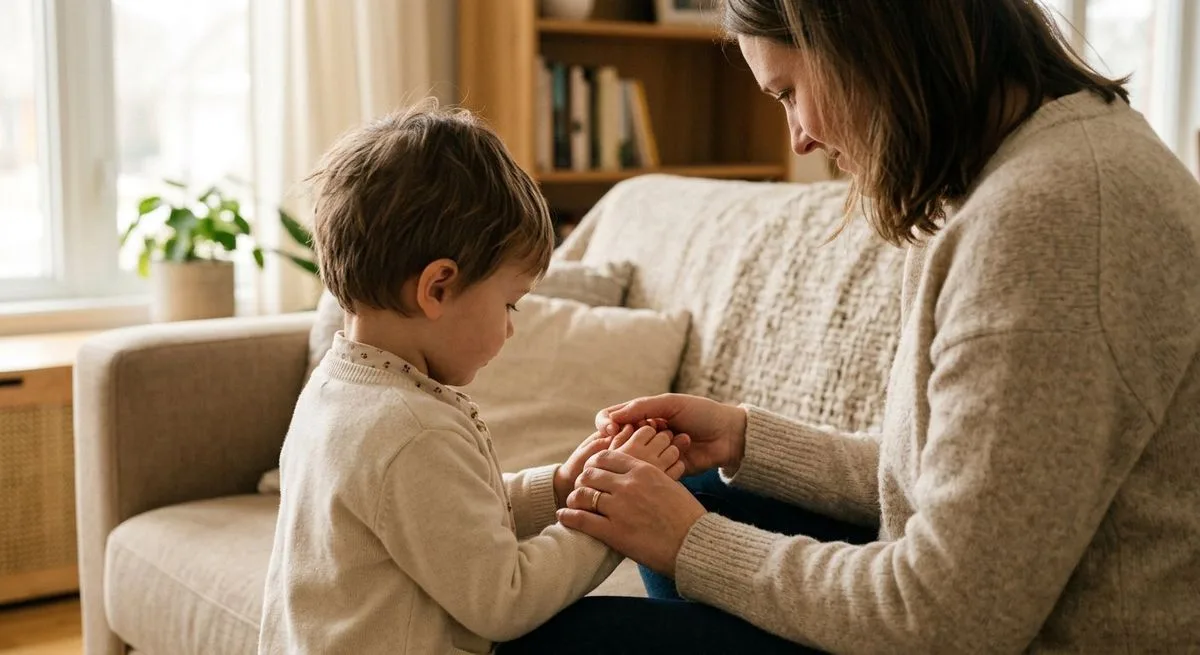

Your child sways when walking — as if stepping on cotton wool. Reaches for a cup — and drops it. Tries to tie their shoelaces — and the fingers just won't cooperate. Every single day. Parents watch this and wonder: why can't he do something so simple?
It's not laziness. It's not carelessness. It's not something he'll simply "grow out of." If your child has been diagnosed with cerebellar ataxia, there's a specific reason behind these struggles — and it's something you can work with. Sensory integration is one way to help a child regain control over their own body. Right at home, every day, with no expensive equipment required.
The Cerebellum, Ataxia, and Sensory Integration — in Plain Language
The cerebellum is the brain's "movement coordination center." It's a small structure at the back of the brain that does an enormous job: it receives signals from all over the body — which foot is on the ground, how far the hand is from the cup, at what angle the head is tilted — and instantly sends precise commands back to the muscles.
When the cerebellum is damaged — by injury, infection, or a congenital condition — this coordinator goes "on strike." Signals from the body still arrive, but they're processed incorrectly. The brain tells the legs "walk straight" — and the gait comes out wobbly. The hand reaches for a spoon — and misses. That's ataxia: not muscle weakness, but a breakdown in coordination.
Now picture sensory integration as a "signal-switching station." The body gathers information from the senses — balance from the inner ear, body position from the joints and muscles, the surrounding environment from the eyes — and sends it to the brain, which then builds a response: where to move the hand, how to keep balance, how hard to grip a pencil.
In a child with a damaged cerebellum, this station malfunctions. Signals get scrambled or interrupted, and the body "stops listening." Sensory integration training helps gradually repair this station — through targeted stimulation and practice.
What Sensory Integration Training Actually Does
Four things happen when a child trains regularly.
The body relearns how to read its own signals. After cerebellar damage, a child may not be able to tell the difference — is he standing on flat ground or a slope? How hard is his hand pressing on the pencil? Repetitive exercises — rocking, walking across different textures — help the body "re-memorize" the correct signals and reduce the confusion.
The brain builds new neural pathways. Neuroplasticity is the brain's ability to rewire itself. Even with a damaged cerebellum, regular training can "teach" other brain regions — the cerebral cortex, for instance — to take over part of the coordination workload. It's like a main road being destroyed and the brain building detours around it.
Balance and movement start working together. The biggest problem in ataxia is that the body is unstable and movements are imprecise. Balance exercises force the vestibular system, proprioception (the sense of body position), and vision to "work as a team." Stable movement patterns gradually form.
The child grows more confident. When he manages to pick up a spoon on his own, take a few steps without support, or catch a ball, a feeling of "I can do this" takes hold. For a child who faces his body letting him down every single day, that feeling is priceless. He becomes more willing to try new things, less fearful, and more trusting of himself.
Exercises for Home: 4 Types of Training
Below are exercises you can do at home. No special equipment is needed. The golden rule: consistency matters more than intensity. Ten minutes every day beats an hour once a week.
Vestibular Training — Improving Balance

The vestibular system (located in the inner ear) is responsible for helping a child sense where "up" and "down" are and hold the body steady in space. In ataxia, these signals are processed incorrectly — hence the unsteady gait and dizziness.
"Airplane." The parent lies on their back and bends their knees. The child lies belly-down on the parent's shins. The parent gently lifts the child (as if for "takeoff") and slowly tilts them from side to side. Duration: 1–2 minutes at a time, 2–3 times a day.
✅ Effect: Gentle tilting stimulates the vestibular system and helps the child sense the body's position in space — up, down, left, right.
Slow swinging on a swing. A regular backyard child's swing works fine, or even a parent's lap. Start with gentle forward-and-back motion, then add side-to-side. Increase the range of motion gradually, from minimal to moderate. Start with 1 minute.
⚠️<span> </span>Caution:<span> </span>If your child becomes dizzy, stop immediately. Start with an adjustment period — literally 10 seconds — and gradually build up the time.
Proprioceptive Training — Teaching the Body to Sense Itself

Proprioception is the body's ability to know where its own parts are without using the eyes. When you touch your finger to your nose in the dark, that's proprioception at work. In children with ataxia, this system is weakened, which is why movements come out imprecise.
"Close Your Eyes and Touch Your Face." The child closes their eyes. The parent names a body part: "touch your nose," "touch your left ear," "put your hand on the top of your head." The task is to find it precisely, without peeking. 5–10 prompts per session.
✅ Effect: The child learns to navigate their own body without relying on sight — exactly the skill that suffers when the cerebellum is damaged.
"Heavy Work." Give the child tasks that require effort: carrying a bag of books (light enough to manage), pushing a box across the floor, kneading dough, squeezing and releasing a stress ball. The muscles and joints receive a strong flow of signals about body position.
✅ Effect: Loading the muscles and joints is the most direct way to "wake up" proprioception. The child gets a better sense of their body and moves with more confidence.
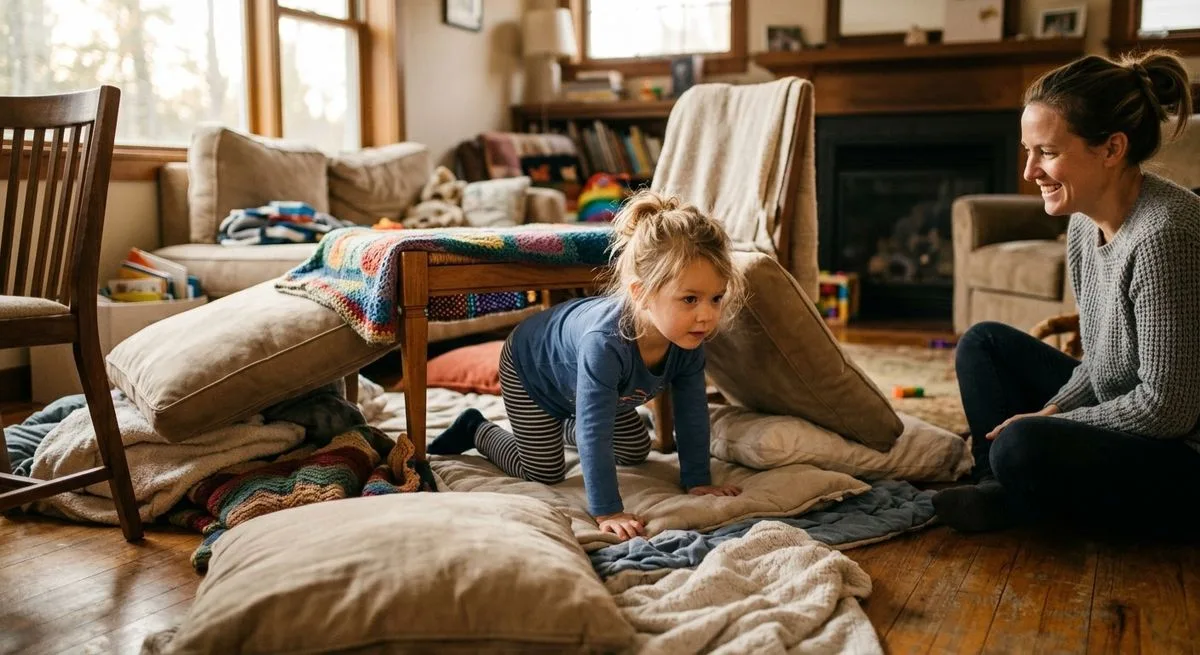
"Obstacle Course." Build a simple course out of pillows, chairs, and blankets, where the child has to crawl, step over, and squeeze through. The child is constantly forced to adjust their body to the space — and the proprioceptive system gets an active workout.
⚠️ Caution: Clear sharp corners and hard objects from the path. Walk the course together with the child the first few times, holding onto them.
Tactile Training — Developing the Sense of Touch
The tactile system isn't just "I feel it when I touch it." It's the ability to distinguish textures, temperature, and pressure. With sensory integration difficulties, a child may either avoid touch altogether or, conversely, fail to notice it. Training helps the tactile system work more precisely.
"Mystery Bag." Put 5–7 objects of different shapes and textures in an opaque bag: a pinecone, a spoon, a block, a small ball, a seashell, a clothespin. The child reaches into the bag and tries to guess what it is by touch alone (no peeking). Start with 3–4 simple objects and gradually add more complex ones.
✅ Effect: The hands learn to "see" without eyes. The brain receives tactile signals and learns to interpret them correctly — which directly helps with everyday actions like buttoning a shirt or holding a pencil.
Walking on different surfaces. Lay out a "path" on the floor made of different materials: a towel, foil, bubble wrap, a shag rug, a smooth board. The child walks barefoot along this path. You can add a basin of warm water and a basin of cool water as "stations" along the way.
✅ Effect: The feet receive a variety of tactile signals that activate both the vestibular and proprioceptive systems at once — triple stimulation in a single exercise.
⚠️ Caution: Watch the child's reaction. If a particular texture causes real discomfort, don't push it. Remove it and try again in a few days.
Visual-Motor Coordination — Teaching the Eyes and Hands to Work Together
Visual-motor coordination is when the eyes see a target and the hands carry out the action precisely — catching a ball, pouring water into a glass, drawing a circle. In ataxia, this process breaks down: the eyes "say" one thing, and the hands do another.
"Catch the Ball." Stand about a meter away from the child and gently toss them a large, light ball (an inflatable beach ball works well). The task is to catch it with both hands. Start at close range with slow throws, then gradually increase the distance. 5–10 throws per session.
✅ Effect: The brain learns to calculate trajectory and speed — and to send the "command" to the hands at the right moment. This trains exactly the coordination that suffers in cerebellar ataxia.
Connect-the-dots drawing. Draw or print simple dot outlines: a circle, a square, a star. The child connects the dots with a pencil. Start with large dots spaced far apart, then gradually shrink them.
✅ Effect: The hand learns to follow the eyes. Fine motor skills are trained gently and without pressure — the child is drawing, not "completing an assignment."
Stringing beads. Use large wooden beads and a thick cord. The task is to string the beads one after another. Once this becomes easy, move on to smaller beads and a thinner string.
⚠️ Caution: Don't rush. If the child gets frustrated, take a break. Go back to an easier version. Progress with these exercises can be slow, and that's completely normal.
What NOT to Do: Common Parenting Mistakes
The urge to help your child is only natural. But sometimes it pushes parents toward actions that hinder more than they help.
Overstimulation. "The more we train, the faster it'll help." No. A child's nervous system with ataxia is already working at its limit. Too many exercises at once, sessions that run too long, stimuli that are too intense (fast spinning, loud noises) — all of it becomes overwhelming. The child gets tired and starts avoiding the sessions altogether. Short sessions every day beat a marathon once a week.
Comparing to other children. "Look, Johnny's already running around, and you're still…" — this hurts. A child with cerebellar ataxia puts in far more effort for things that come easily to others. Measure his progress against his own scale, and nothing else. Couldn't hold a spoon yesterday — held it 3 seconds longer today. That's a win.
Chasing fast results. Parents want to see progress quickly. But neuroplasticity is not a fast process. The brain builds new pathways over weeks and months. If a task feels harder for the child today than it did yesterday, that's not a setback — the nervous system is rewiring itself, and "bad days" are part of the process. Don't make an exercise harder until the current level has become genuinely easy.
Doing it FOR the child. When a child fumbles with a button for a while, the instinct is to reach over and button it yourself. But every independent attempt is training for the nervous pathways. Help only when the child asks for it — or when you see them right on the edge of frustration, and then help just a little, without finishing the task for them.
Every small achievement your child makes is a new neural pathway their brain has built. Held onto the spoon. Walked two steps without support. Caught the ball. These aren't small things — they're victories.
Sensory integration training doesn't promise miracles in a week. But it gives a child what they need most: the chance to reclaim control over their own body, one step at a time. And the feeling that they can.
Start with one exercise. Any one. Whichever one your child enjoys most. Do it every day. Then, in a week, add another. You're already on this path — you're reading this article, after all.