Communication Struggles: Questions Parents Ask
"My child keeps repeating words, but other kids don't understand him and don't want to play with him"
"When my child needs something, he never asks for it in words — he just pulls me by the hand"
"Why can my child speak, but still can't express his thoughts properly when talking to others?"
These are common questions parents of children with autism ask. Most of these children genuinely struggle with speech and communication, and often withdraw into their own world.
While it may sometimes look like a child with autism already has communication skills, it's important to understand: these skills need to be taught deliberately and practiced consistently.
Communication Challenges in Children with Autism
Communication is the exchange of information between people. It can be verbal (speech) or nonverbal (gestures, facial expressions). Genuine communication happens when two people respond to one another.
However, most people with autism find it difficult to interact with those around them. They may struggle to:
- Initiate communication
- Respond to others
- Show or point things out during interaction
- Express friendliness
Because of these difficulties, understanding others and taking part in everyday life — at home, at school, at work — can be significantly harder for them.
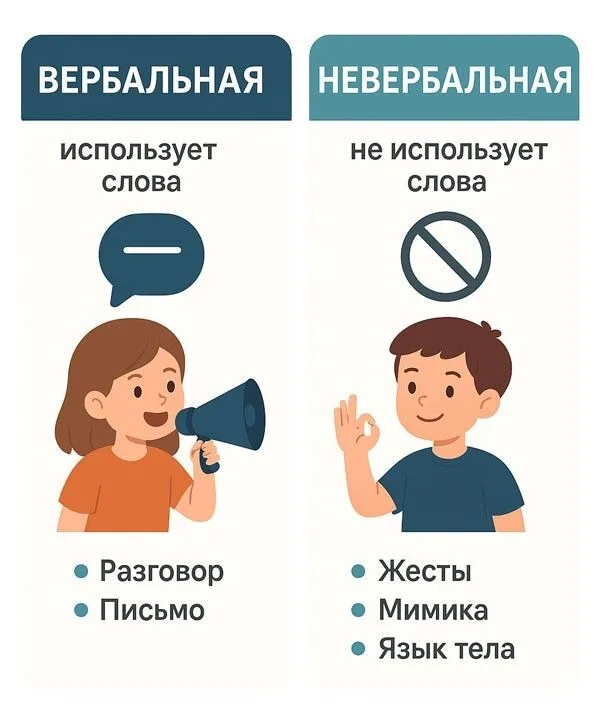
Nonverbal Communication
Some children with autism have delayed speech development, and some adults never begin speaking at all. In these cases, finding alternative ways to communicate becomes critically important.
A child with autism may:
- Not respond when spoken to
- Appear indifferent
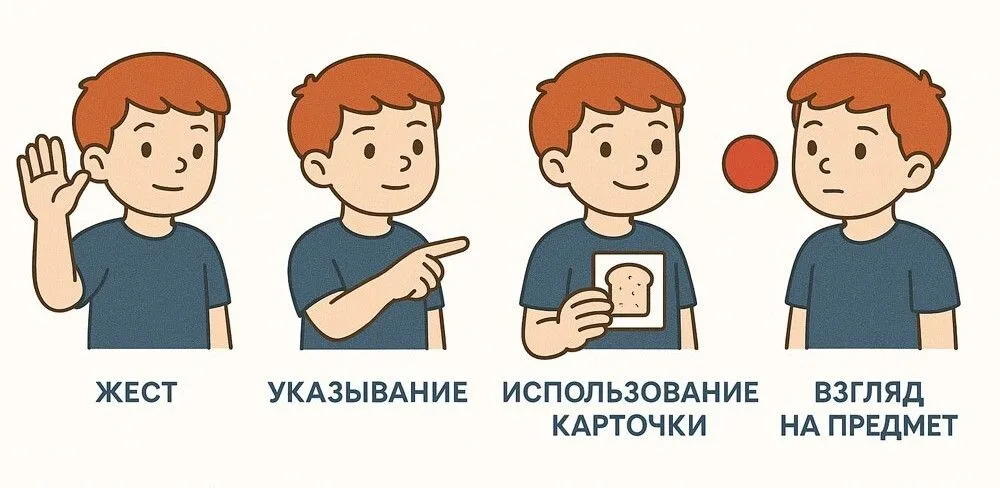
- Use gestures, crying, or lead an adult by the hand
- Look at or reach for the object they want
- Use PECS cards
- Show challenging behavior
- Repeat other people's words (echolalia)
Echolalia (Repeating Speech)
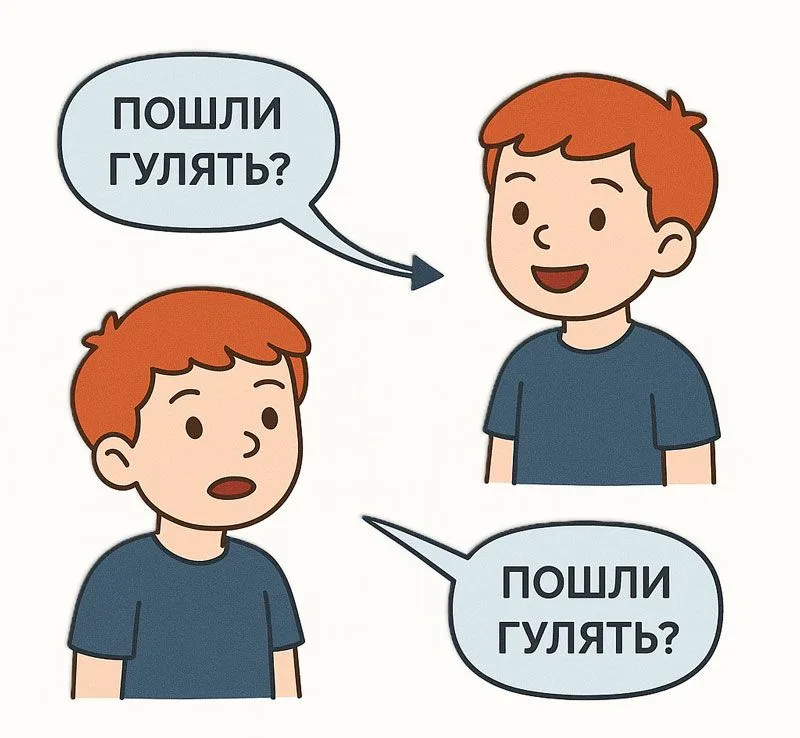
Some children repeat words without understanding their meaning. But echolalia can also be meaningful!
For example:
- If a child repeats a question back, it may simply mean they don't know the answer → Use visual support (pictures, choice boards)
- If they memorize phrases from cartoons → Try to understand what they're trying to express through them
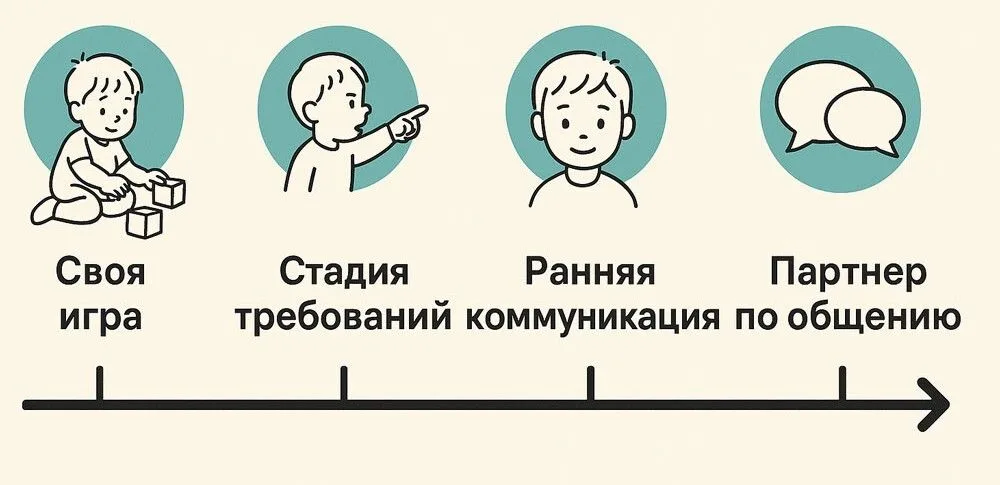
4 Stages of Communication in Children with Autism
The level of communication depends on:
- The ability to interact with others
- The methods and purposes of communication
- The level of understanding
Unintentional Communication
The child doesn't realize that their actions affect others. This may be self-soothing behavior or a reaction to external stimuli.
Intentional Communication
The child consciously conveys a message (for example, expressing protest or making a request).
The 4 stages according to the Hanen program:
- "Own Agenda" — the child plays alone; communication is pre-intentional.
- "Requester" stage — the child begins to understand their influence on others (pulls by the hand, points at objects).
- "Early Communicator" — more conscious interaction emerges, along with eye contact.
- "Partner" — the child uses speech but may still struggle in unfamiliar settings.
8 Techniques to Improve Communication
1. Follow the Child's Lead
Don't impose your own rules. If they've only just started speaking, use simple words and gradually expand phrases (for example, from "car" to "blue car").
2. Don't Rush to Help
Give them time to try on their own. Ask, "Do you need help?", wait, and repeat the question if needed.
3. Communicate Face to Face
Get down to the child's level so they can see your facial expressions and gestures.
4. Imitate Their Actions
Tap a spoon, clap your hands — this draws attention and lays the groundwork for a dialogue.
5. Use Visual Support
Use gestures ("yes/no"), photos of family members, and picture schedules.
6. Sing and Play Roles
Sing together and act out short scenes ("How do you say hello?", "What do you say if you're upset?").
7. Praise Every Attempt
"Great job pointing with your finger!" — this helps the child connect a communicative action with a positive response.
8. Create Opportunities to Communicate
- Put a favorite toy on a high shelf → encourage a request for help
- Give toys that require assembly → encourage joint play
- Use bubbles or balloons → turn them into a dialogue
Alternative and Augmentative Communication (AAC)
If a child doesn't speak, alternative communication gives them a "voice." Without a way to express themselves, they may experience intense stress.
Types of AAC:
- PECS (Picture Exchange Communication System)
- Sign languages (Makaton, BSL)
- Communication boards and books
- Speech-generating devices
Take the First Step Toward Understanding
Communication is possible at any level — the key is finding the right method and creating an environment where the child feels understood. Every small step forward in communication is a victory that opens up new possibilities for engaging with the world.
If you're noticing communication difficulties in your child, don't put off reaching out to specialists. Starting early with a speech therapist, psychologist, and other professionals who specialize in autism significantly improves the chances of developing effective communication.
Book a consultation today and take the first step toward helping your child find their voice and be heard.