
Many people still assume that autism inevitably comes with intellectual impairment. That assumption doesn't quite match reality. Let's look at what the current evidence and clinical experience actually tell us about intelligence in children with autism.
The Myth of Autism and Intellectual Disability: What Do the Facts Say?
How Our Understanding of Autism and Intelligence Has Evolved
Early in the study of autism, researchers assumed these children had no intellectual impairments at all. Later it became clear that many do have a co-occurring intellectual disability.
IQ Statistics in Autism
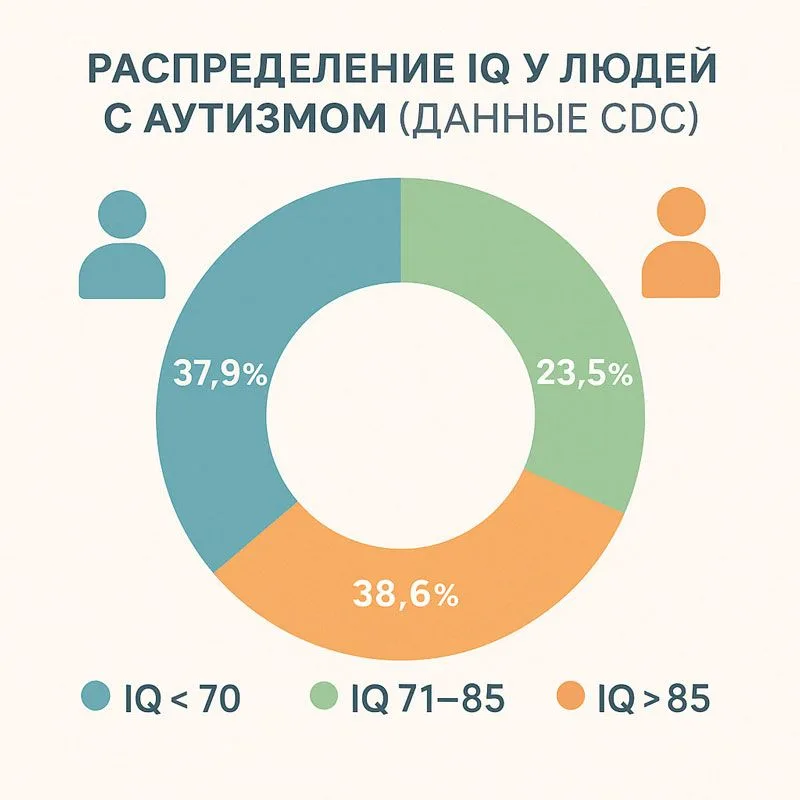
In March of this year, the US Centers for Disease Control and Prevention (CDC) published fresh data on IQ levels among children with autism:
- IQ below 70 (the intellectual disability range) — roughly 37.9%.
- Borderline intellectual functioning (IQ 71–85, between typical range and disability) — roughly 23.5%.
- IQ above 85 (average and above average) — roughly 38.6%.
While China doesn't have equally precise statistics, clinical experience points to a similar pattern: roughly a third of children with autism fall into each of these three groups (below 70, borderline, and average or above).
For families raising a child with autism, the question of intelligence matters a great deal. Can IQ change? What does a "high IQ" actually mean? And what if the IQ is low?
Can a Child with Autism's IQ Change?
Brain Plasticity and Early Development (Before Age 5)
A child's brain, especially before age 4–5, is highly plastic. During this window intelligence can shift considerably, particularly in children with developmental delays. With targeted therapy (early intervention) and support, measures of intelligence — a developmental quotient or IQ score — can gradually rise.
IQ is generally considered to stabilize after age 5–6. If a child without autism still has an IQ and adaptive behavior score (self-care, communication, social living skills) below 70 at that age, clinicians may start talking about "intellectual disability" rather than "developmental delay," since the odds of a substantial IQ increase drop from that point on.
A case from clinical practice: a child is diagnosed with "global developmental delay" at age 2. After 1–2 years of therapy, motor skills and comprehension improve by age 4, but speech lags behind — the diagnosis shifts to "speech development delay." After further speech work, by age 5–6 the IQ and other measures can return to the normal range.
How IQ Can Still Change in Autism After Age 5
- Early intervention: Intensive, evidence-based therapy, a stimulating environment, and gains in social and language skills can help bring IQ into the typical range.
- Crystallized intelligence: This type of intelligence depends on learning and accumulated experience. The narrow but deep interests many children with autism have — reading, building and construction, and so on — can boost their test performance.
- Cooperation during testing: As a child gets better at regulating emotions and behavior over time, they're able to demonstrate their true abilities more accurately during IQ testing.
Why Regular IQ Assessment Matters in Autism
Children develop, and their abilities change along the way. That's why regularly reassessing intelligence (dynamic IQ testing) is important — it shows the trajectory and helps fine-tune the intervention plan. Recommended testing frequency:

- Under age 2: every 3–6 months.
- Ages 2–4: every 6–12 months.
- Age 4 and older: annually.
- After age 6–7: every 2–3 years.
If results stay stable over 3 years, they most likely reflect the child's genuine abilities. If the numbers keep shifting, that's a signal to revisit the intervention plan.
Children with Autism and a High IQ
Occasionally clinicians see children with autism who have a very high IQ — up to 140, considered the genius range.

Why Are They Diagnosed Later?
Their autism diagnosis is often made later, because the symptoms tend to be less obvious:
- They understand language well, reason logically, and pick up new things easily.
- Their interactions with parents can mask underlying difficulties.
- Problems become more apparent in the later preschool or school years.
Characteristic Traits
Despite the high intelligence, the core features of autism are still there:
- Repetitive behaviors, along with very narrow and intense interests (say, only space, or only insects).
- Interests that diverge sharply from their peers' (an interest in machinery instead of toys, for example).
- Difficulty with social communication: they may not notice other children or may only talk about the topics that interest them.
- Emotional and behavioral difficulties are also possible.
A High IQ Doesn't Guarantee Easy Schooling: Challenges in Autism

Children with autism who have a high IQ can be excellent at memorizing facts — animal names, historical dates — or excel at exact sciences if numbers interest them.
But they often struggle with:
- Analyzing what they've read and drawing conclusions.
- Understanding figurative meaning, hints, and irony (which is why language and literature classes are often a struggle).
- Connecting knowledge across different subject areas.
This can lead to uneven school performance — excelling in math, for instance, while struggling with the humanities (a "lopsided" academic profile).
Low IQ in Autism: Focus on Adaptive Skills
For children with autism and their parents, a few things are worth keeping in mind:
- IQ can improve, especially with early and appropriate intervention.
- When the room for IQ growth is limited, the priority should shift to building adaptive behavior.
What Are Adaptive Skills?
These are self-care skills (getting dressed, eating, using the toilet), everyday practical skills, and the ability to navigate simple social situations — in short, everything that helps a person live independently.
When Is "Intellectual Disability" Diagnosed?
An "intellectual disability" diagnosis is only made when two conditions are met together: IQ below 70 and an adaptive skills score below 70.
Adaptive Skills Matter More Than the Numbers
What Really Matters Is Independence, Not IQ: What Should Parents Do?
Don't get fixated on the IQ number alone. Every child with autism has their own potential for growth. Starting intervention early, tracking progress with regular assessments, and — most importantly — focusing on the life skills that lead to independence will help your child reach the best outcome possible.
Understanding your child's individual developmental profile is the key to helping them effectively. If you'd like a professional developmental assessment, want to discuss the right intervention approach, or need help building a personalized support plan, don't wait to reach out to specialists.