
He gets carsick within five minutes. He can't walk along a curb without hopping off. He falls over when other kids his age are already running circles around him. In a chair, he spins like a top and can't sit still for a second. If you recognized your child in even one of these, the cause might not be personality. And it's probably not just "clumsiness." It could be a vestibular processing issue. Let's look at what that actually means, how it shows up, and what you can do about it.
The Vestibular System: The Body's Internal GPS
Imagine your child has a built-in GPS. Except instead of plotting a route across town, it tracks the body's position in space — which way is up, which way is down, whether you're moving fast or standing still, whether you're leaning forward or backward. All of this information comes from the vestibular apparatus, located in the inner ear, and streams to the brain in real time.
Based on these signals, the brain does three things:
- Maintains balance. It adjusts posture so the child doesn't wobble while walking or topple over while standing.
- Coordinates eyes and head. This keeps the visual field steady — not blurring or jumping — when the head turns.
- Provides spatial orientation. It helps judge distance to an object, the height of a step, or the slope of a slide.
When this "GPS" glitches, everything gets harder for the child. The signals it receives are inaccurate or delayed, and the body reacts accordingly — swaying, misjudging distances, losing its footing.
How to Tell If Your Child Has a Vestibular Processing Issue
Vestibular dysfunction isn't always obvious. It can disguise itself as "clumsiness," "hyperactivity," or "odd habits." Here's what to watch for.
Balance and coordination. The child trips and falls on flat, even ground. When running, the arms and legs seem to move independently of each other. Repetitive rhythmic movements — clapping to a beat, marching, jumping rope — are hard to do.
Sensitivity to movement. The child gets carsick quickly, in the car or on a swing. When turning the head, the eyes can't hold focus — objects seem to "swim." The child may avoid merry-go-rounds, or, conversely, avoid slides and stairs — any situation where the body's position changes suddenly.
Behavior and attention. The child is restless and struggles to sit still. Rocking in a chair, spinning in place, shaking the head — this isn't misbehaving. It's a form of self-stimulation: the body is trying to "reach" the vestibular system and get the input it isn't receiving enough of.
If several of these match your child, it's worth consulting a sensory integration specialist. But there's plenty you can start doing right now.
Exercises to Train the Vestibular System
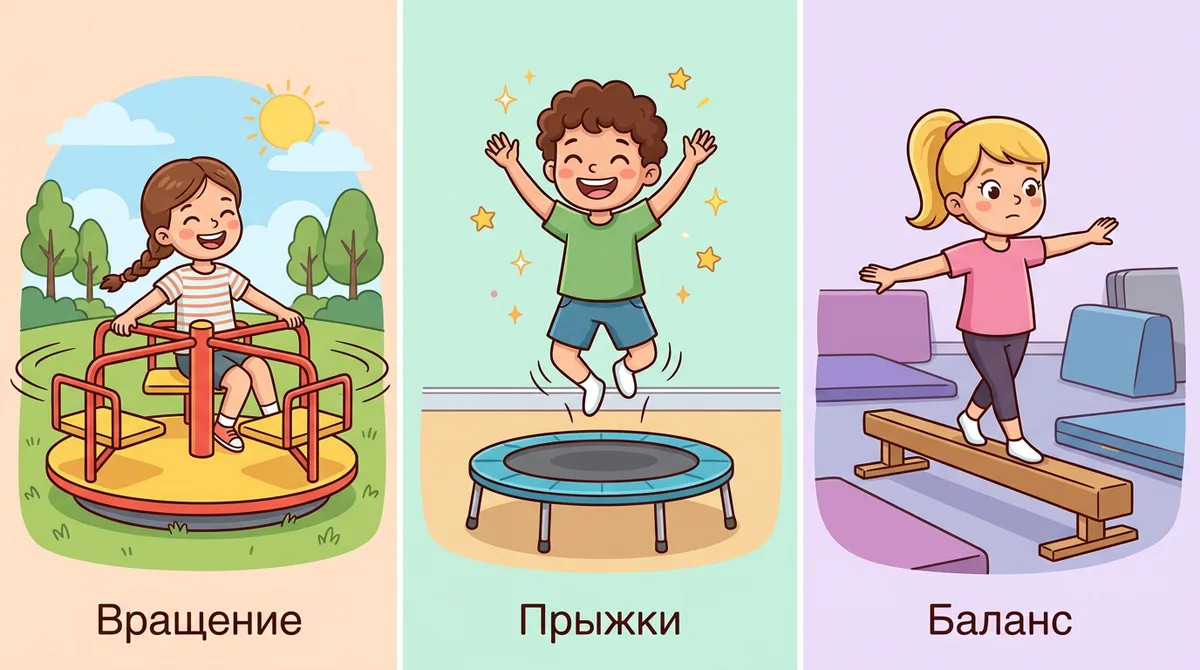
The main rule: for the child, this needs to feel like play, not "training." No pressure — just fun. All the exercises fall into three groups.
Spinning: Turning On the "Merry-Go-Round"

Spinning is one of the most powerful stimuli for the vestibular system. The brain receives an intense stream of signals and learns to process them.
- Playground merry-go-round. Start with slow spins and gradually pick up speed. Watch the child's reaction — if they're laughing, you're on the right track.
- Swivel chair. Sit the child in a swivel chair and spin them — just a few rotations at first. Turn it into a game: "Spin around and point to where the window is!"
- Sit-and-spin disc. A special rotating disc the child sits on and spins by hand. A great tool for home use.
Jumping: The "Trampoline Workout"

Jumping gently stimulates the vestibular apparatus through the constant up-and-down shift in body position.
- Trampoline. If you have one at home, great. Turn trampoline time into a game — "who can jump higher" or "jump until the music stops."
- Jump rope. Better suited to older children. It also builds coordination, since the child has to swing the rope and jump at the same time.
- Two-footed jumps. The simplest option, and always available. Chalk a hopscotch grid on the pavement, or lay out "islands" of couch cushions on the floor, and jump from island to island.
Balance: The "Tightrope Walker"

Balance exercises force the brain to continuously calculate body position and adjust posture.
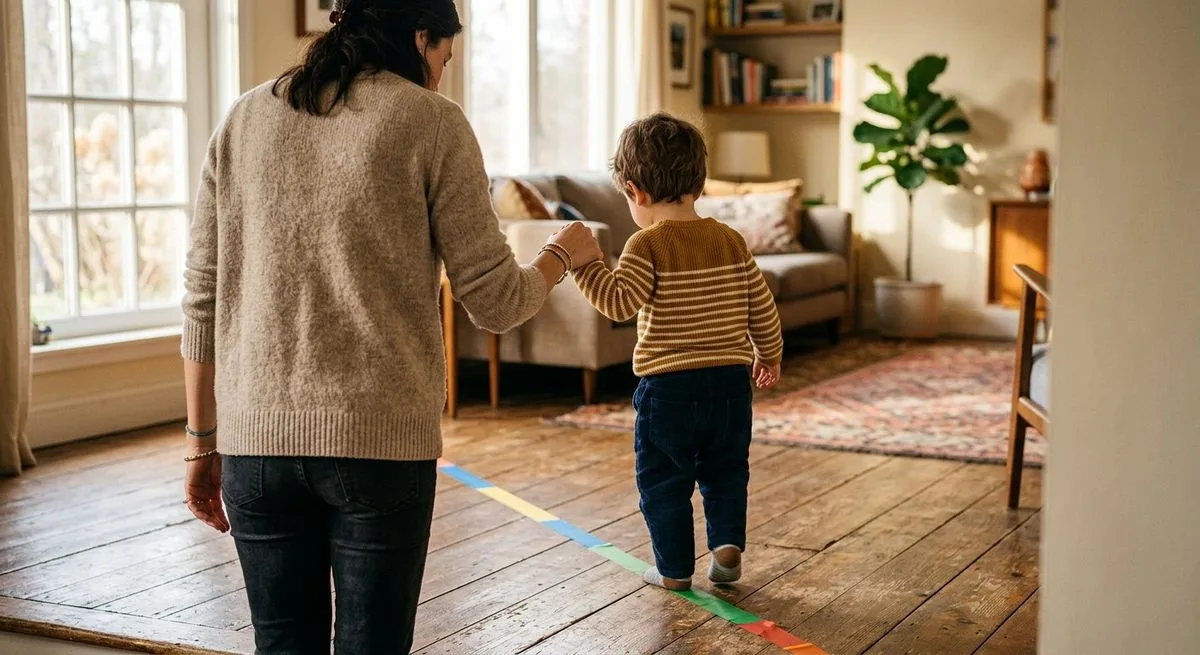
- Walking a beam. A log, a curb, a line of painter's tape on the floor — anything works. The goal is to walk the "path" without stepping off. Make it harder: "Carry a book on your head like a princess!"
- Standing on one leg. Turn it into a contest with mom or dad — whoever holds it longer wins. Start with a few seconds and build up gradually.
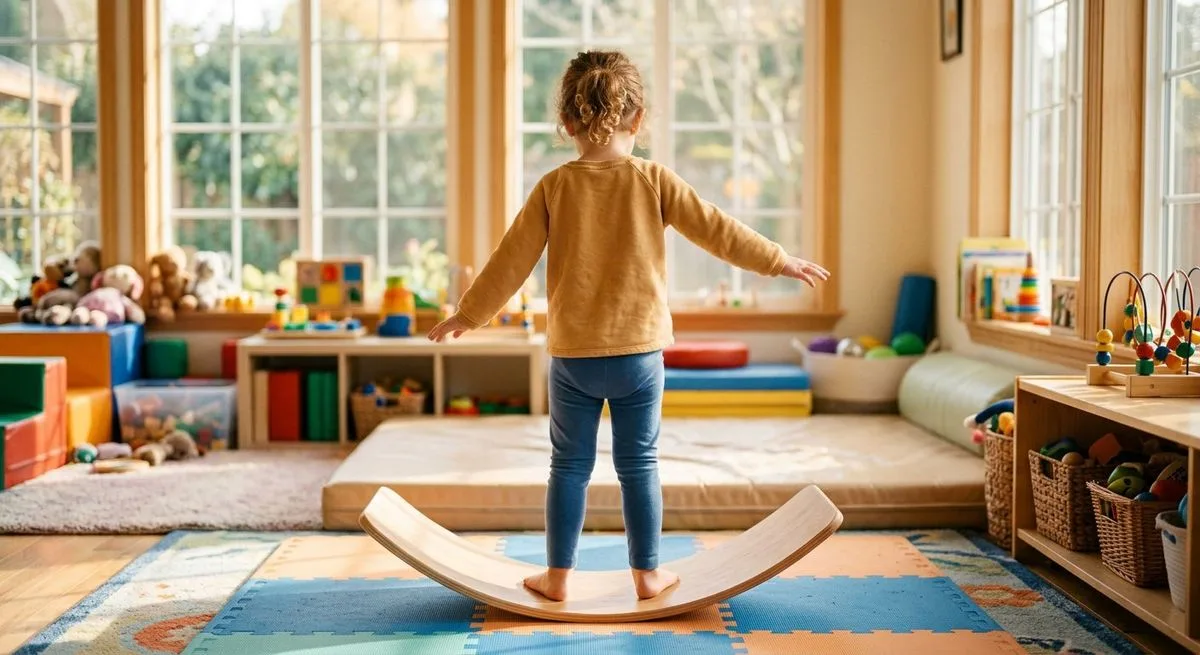
- Balance board. A wobbling board the child has to balance on. For a kid, it feels like surfing — rock back and forth without falling off!
Safety Rules
Vestibular exercises are a powerful tool, and it's important not to overdo them.
Stop at the first sign of discomfort. If the child turns pale or complains of dizziness or nausea, stop the exercise immediately. Let them rest. You can try again later, but keep it gentler and shorter. Overstimulation backfires.
Warm up before starting. Before exercises, loosen up the neck, shoulders, and back with light circular movements. This releases muscle tension and prepares the body for the activity.
Do it together. It's best to do these exercises alongside your child. That means safety (you're right there if something goes wrong) and motivation (it's more fun together). Turn every exercise into a game — hopscotch, "tightrope walker," "who can hold it longer" — and your child will start asking to do it again.
The Key Principle: Go Gradually
The vestibular system isn't trained in a day. Every session is a small step forward. Three seconds on one leg today, five in a week, ten in a month. Two spins in the chair today, three tomorrow. Don't rush your child. Don't compare them to other kids. Notice and celebrate every bit of progress, no matter how small.
If you notice the signs described in this article and at-home exercises aren't making a difference, consult a sensory integration specialist. A professional evaluation can pinpoint exactly what your child needs and help build a personalized correction program.